
Views: 0 Author: Site Editor Publish Time: 2026-06-30 Origin: Site


Scaling a production facility presents a universal dilemma for manufacturers. You must constantly balance upfront Capital Expenditure against long-term Operational Expenditure. Choosing the right equipment involves far more than simply maximizing output speed. It requires aligning your automation strategy with your current labor market dynamics. You also need to consider production demand predictability and your existing facility infrastructure. A mismatch here can drain your resources quickly.
This guide breaks down the true long-term financial impact and operational realities of both automation levels. We explore production capacities, labor dependencies, and essential process nuances. By understanding these critical factors, you can make a risk-averse procurement decision. You will confidently choose the system best suited to your factory's specific growth trajectory and packaging requirements.
Volume Thresholds: Semi-automatic machines are generally optimal for low-to-medium volume runs (typically under 2,000 bottles/hour) or highly customized shapes, while fully automatic machines become cost-justifiable at continuous, high-volume production.
The Labor Trade-off: Fully automatic systems reduce headcount but require higher-paid, specialized maintenance technicians to minimize costly downtime.
Consistency vs. Flexibility: Automatic machines guarantee strict wall-thickness consistency and cycle time predictability. Semi-automatic units offer superior flexibility for frequent mold changeovers and diverse SKUs.
Process Nuances: The ROI math changes depending on whether you are running PET stretch blow molding (where automation heavily impacts heating consistency) vs. extrusion blow molding.
Before evaluating financial metrics, we must establish how each automation tier functions on the factory floor. The mechanical differences dictate your daily operational rhythms.
In a semi-automatic workflow, the process relies heavily on human intervention. Operators manually transfer heated preforms or parisons into the mold cavities. Once loaded, they step back and manually initiate the clamping and blowing cycle via control buttons. This hybrid approach keeps machinery costs low.
However, we quickly identify a core bottleneck. Cycle times remain inherently tied to operator fatigue and manual dexterity. An operator might load preforms swiftly during the first two hours of a shift. By hour seven, physical exhaustion inevitably slows the pace. This creates output inconsistencies. Micro-delays during transfer can also cause the plastic to cool unevenly, occasionally impacting bottle quality.
Conversely, a fully automatic workflow operates as a completely closed-loop system. The equipment handles preform loading, infrared heating, precise transferring, blowing, and final ejection without any human intervention. When you install an automated Blow Molding Machine, you remove the human element from the core production cycle.
The operational advantage here is immense. You achieve continuous, synchronized pacing determined strictly by servo motors and PLC logic. The machine ignores human physical limits. It guarantees that every preform experiences the exact same thermal profile and transfer time. This consistency drastically reduces scrap rates and maximizes yield across multiple shifts.
Choosing between these systems requires a structured approach. We use a four-dimension framework to evaluate the realities of integrating either machine into your facility.
You must carefully analyze realistic cycle times. A standard semi-automatic setup might yield 800 to 1,500 Bottles Per Hour (BPH). In contrast, a modern fully automatic machine easily pushes 4,000 to over 20,000 BPH depending on cavity counts.
Many plant managers attempt to scale by purchasing multiple semi-automatic units. This introduces severe scalability risks. Adding machines yields diminishing returns regarding floor space and labor efficiency. Four semi-automatic machines require four dedicated operators, extensive spacing, and complex conveyor routing. Investing in a single high-capacity automatic unit often preserves valuable square footage while multiplying your output capabilities.
Comparing baseline costs goes beyond the sticker price. We must evaluate both initial investments and ongoing expenses.
CapEx: Semi-automatic machines boast significantly lower base prices, cheaper shipping, and minimal installation complexity. Automatic units require hefty upfront capital and specialized rigging during installation.
OpEx: Automatic systems often feature highly efficient servo-driven heating and clamping components. They lower your per-unit power consumption. Furthermore, automated precision slashes material scrap rates, driving per-bottle production costs down over time.
To determine financial viability, you must calculate your ROI breakpoint. Follow this simple process:
Calculate the upfront price difference between the automatic and semi-automatic systems.
Determine your monthly labor savings by eliminating manual operator roles.
Calculate your monthly material savings derived from lowered scrap rates.
Divide the upfront price difference by your combined monthly savings to find your payback period in months.
The semi-automatic reality demands reliable manual labor. You need dedicated workers for every active shift. This model leaves you highly vulnerable to localized turnover, wage inflation, and human error. Inconsistent preform transfers frequently cause uneven wall distribution, generating defective products.
The fully automatic reality effectively eliminates line-worker headcount. However, it shifts your labor dependency toward higher-tier skills. You will require advanced PLC operators and electro-mechanical technicians. These specialists handle complex troubleshooting and vital preventive maintenance. While you employ fewer people, you must compensate these technicians at premium market rates.
Automation ensures precise thermal profiling. Heated preforms move into the molds at the exact optimal millisecond. This strict material distribution prevents thin spots and potential burst hazards. Consistent wall thickness directly correlates with material savings.
Furthermore, consider your compliance scenarios. Food-grade, pharmaceutical, or high-end cosmetic packaging environments often mandate zero-touch manufacturing. Fully automatic systems minimize human contamination during production. Regulatory standards like HACCP and GMP strongly favor automated, enclosed processes over manual handling.
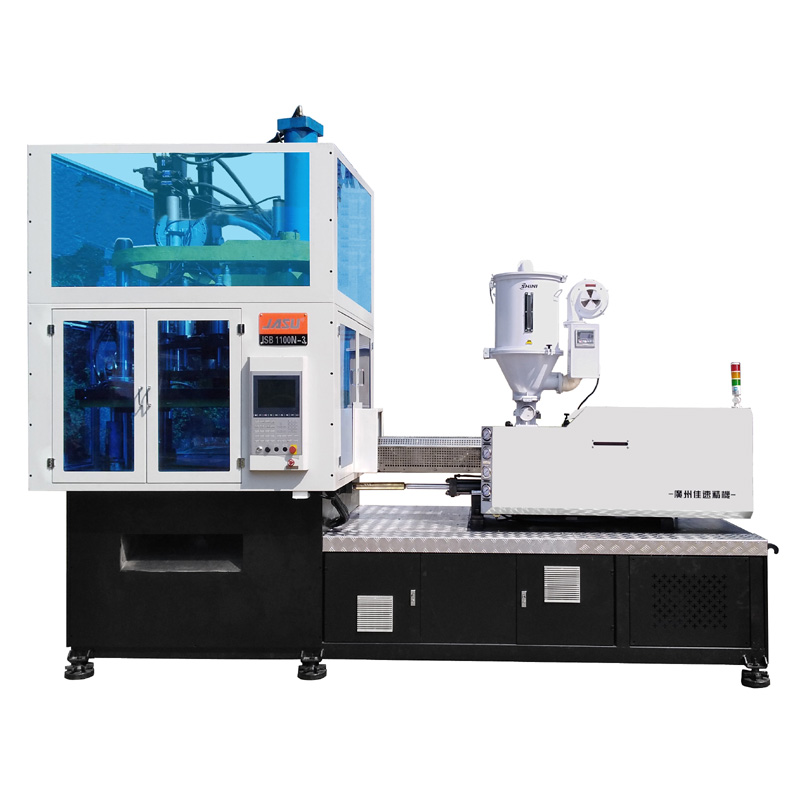
The raw materials and specific manufacturing processes heavily influence your equipment choice. Automation yields different returns depending on the underlying plastic engineering.
In PET stretch blow molding operations, automation is highly recommended. PET properties make temperature control critical during the preform transfer phase. The material requires a very specific, narrow thermal window for optimal stretching. When operators manually move hot PET preforms, they introduce micro-delays. Even a two-second delay causes the exterior plastic surface to cool unevenly. This results in poor material distribution and weakened bottle structures. By utilizing an automated Blow Molding Machine, you lock in the thermal profile. The robotic arms transfer preforms in a fraction of a second, guaranteeing identical structural integrity across millions of bottles.
Extrusion blow molding presents a vastly different scenario. This process involves dropping a continuous, molten tube of plastic (a parison) directly into the mold. Materials like HDPE or PP require extensive cooling times within the mold cavity before ejection. Because the cooling phase naturally elongates the cycle time, operator speed is rarely the primary bottleneck.
Therefore, semi-automatic configurations remain highly viable and cost-effective here. If your factory produces large, complex hollow parts—such as 20-liter jerrycans, agricultural tanks, or industrial drums—the slow pacing suits manual operators perfectly. The heavy capital investment required for large-scale automated extrusion setups often outweighs the minimal time saved during the lengthy cooling phases.
Procurement teams often overlook the profound facility upgrades required when jumping between automation tiers. A machine never operates in isolation.
Automatic machines demand a continuous inline footprint. They require rigid alignment with downstream conveyors, labelers, and palletizers. You need long, uninterrupted stretches of factory floor. Semi-automatic setups offer a modular, disconnected layout. You can place the heating oven in one corner and the blowing chassis a few feet away, curving the workflow to fit tight or awkwardly shaped buildings.
Upgrading to fully automated equipment stresses your existing infrastructure. High-speed automatic units require massive volumes of high-pressure clean air. You will likely need to purchase proportional upgrades to your high-pressure air compressors. Additionally, rapid cycle times generate immense heat, requiring more robust industrial chillers. Without upgrading these auxiliary components, your expensive new machine will suffer from chronic downtime.
Fully automated servo-systems draw a much higher baseline of power. More importantly, they require incredibly stable voltage. A voltage drop that merely slows down a semi-automatic machine can trigger a hard fault in a complex PLC logic board. Facilities operating in regions with unstable electrical grids must invest in heavy-duty voltage regulators before installing fully automated production lines.
To finalize your procurement strategy, review this comparative decision matrix. It aligns your business goals with the correct mechanical solution.
Evaluation Criteria | Semi-Automatic Systems | Fully Automatic Systems |
|---|---|---|
Production Volume | Low to Medium (Under 2,000 BPH) | High to Continuous (4,000+ BPH) |
SKU Diversity | High. Excellent for custom, varied runs. | Low. Best for consistent, long runs. |
Labor Strategy | Relies on accessible manual labor. | Requires skilled PLC technicians. |
Capital Strategy | Preserves upfront cash reserves. | Requires heavy initial investment. |
Your production schedule requires frequent mold changeovers across diverse, short-run SKUs.
Local manual labor remains highly accessible and inexpensive.
Capital preservation stands as your primary immediate business goal.
You manufacture large, thick-walled extrusion containers requiring long cooling periods.
You plan on running continuous, high-volume shifts (24/7 or 20/6) focused on limited SKUs.
Labor shortages, high turnover, or wage inflation actively threaten your profit margins.
You are entering supply chains (food, medical) that mandate zero-touch, high-consistency manufacturing protocols.
You utilize sensitive PET preforms requiring flawless thermal consistency.
There is no universal "better" machine on the market. There is only the right equipment for your factory's current growth stage and local economic realities. Semi-automatic units provide brilliant flexibility and ease the burden of upfront costs. Automated systems deliver unmatched precision, scale, and long-term per-unit savings.
Procurement teams must calculate their operational viability not just on the machine's initial sticker price. You must analyze a 3-to-5 year projection encompassing labor wages, scrap reduction, utility consumption, and maintenance overhead. Avoid making rapid judgments based purely on catalog output speeds.
Take actionable steps today. We encourage buyers to request a customized financial impact analysis. Reach out to equipment engineers to run a detailed cycle-time simulation based exclusively on your specific bottle designs and local labor rates. Data-driven modeling removes the guesswork from your next major equipment upgrade.
A: Generally, no. Upgrading is rarely feasible due to fundamental differences in chassis design. Fully automatic machines rely on integrated PLCs and complex servo-driven preform transfer mechanisms. Semi-automatic frames cannot support these closed-loop additions. You should purchase a fully automated system from the start if you anticipate rapid volume growth.
A: The realistic payback period typically ranges from 18 to 36 months. This timeline heavily depends on your daily output volume and local labor replacement costs. Facilities running continuous 24/7 shifts will realize ROI much faster than those operating single daily shifts.
A: This is a common misconception. While their baseline electrical draw is lower, energy cost per bottle is almost always higher. Semi-automatic setups suffer from thermal inefficiencies and slower cycle times. Fully automated systems utilize efficient servo-motors, effectively lowering the per-unit energy consumption significantly.
A: Historically, yes. Automatic machines require precise calibration for transfer arms and complex heating profiles. However, modern equipment features quick-change mold systems. These innovations have drastically reduced downtime. Today, skilled technicians can complete automatic mold changeovers almost as quickly as manual setups.
