
Views: 0 Author: Site Editor Publish Time: 2026-10-22 Origin: Site


Clear plastic packaging demand is surging rapidly across the modern retail landscape. This growth is especially visible within the food, cosmetic, and pharmaceutical sectors. Consumers increasingly want to see the physical product they are buying. Consequently, this preference has driven a massive shift toward highly transparent, premium containers.
Furthermore, the packaging industry is currently undergoing a structural transformation. We are witnessing a massive migration from traditional heavy glass to shatterproof PET alternatives. E-commerce logistics demand lightweight, durable packaging to reduce shipping costs and prevent breakage. Meanwhile, global sustainability mandates are pushing brands toward thinner container walls without compromising top-load strength. This intersection of market trends makes precise machine sizing more critical than ever. However, navigating the procurement of manufacturing equipment is far from a simple catalog purchase. It requires a rigorous engineering approach, starting with a deep understanding of your exact product dimensions.
In this comprehensive guide, we will demystify the machine selection process. We will explore how fundamental geometric factors—such as jar diameter and required cavity counts—dictate the mechanical specifications of your manufacturing equipment. Understanding these principles ensures you avoid costly procurement mistakes.
Space dictates capacity: Larger jar diameters inherently require wider mold pitches. This physical limitation naturally restricts the maximum number of cavities a specific machine can accommodate between its structural tie-bars.
Tonnage matters: Higher cavity counts significantly increase the required injection pressure. Machines must therefore possess greater clamping force to maintain mold closure and ensure defect-free production.
Industry-specific needs: Whether sourcing a high-volume food packaging system or specialized cosmetic equipment, exact product dimensions dictate your mold tooling complexity and overall machine footprint.
ROI balance: Deploying a smaller, lower-cavity system often offers superior production flexibility and a faster return on investment for wide-mouth products compared to massive, high-cavity platforms.
Injection Stretch Blow Molding, commonly known as ISBM, is a highly advanced 1-step manufacturing process utilized to produce premium plastic containers. Unlike traditional 2-step processes where preforms are manufactured on one machine, cooled, stored, and then reheated and blown on another, 1-step ISBM performs the entire operation within a single unified platform. The process begins by injecting molten plastic into a preform mold. The still-hot preform is then transferred to a conditioning station to achieve an optimal temperature profile before being physically stretched and blown into its final shape.
Because the preform never leaves the machine environment and retains its latent heat, 1-step ISBM technology is vastly superior for producing flawless, highly transparent, and scratch-free containers. Investing in the correct equipment guarantees precise neck finishes and uniform wall distribution. These are critical quality parameters for premium packaging sectors.
When engineers evaluate equipment for standard narrow-neck water bottles, the primary focus is often sheer production volume. In stark contrast, a PET jar blowing machine deals with entirely different geometrical challenges. Jars and cans feature significantly wider bodies, larger neck diameters, and often thicker walls.
These unique dimensions directly impact the fundamental mechanics of the molding equipment. A wider neck requires a larger injection core and cavity, demanding a much more robust hot runner system. The overall diameter of the jar dictates how much physical space each container occupies within the blowing station. Ignoring these dimensional realities during the procurement phase often leads to purchasing equipment that either cannot physically house the required molds or lacks the mechanical force to operate them efficiently.
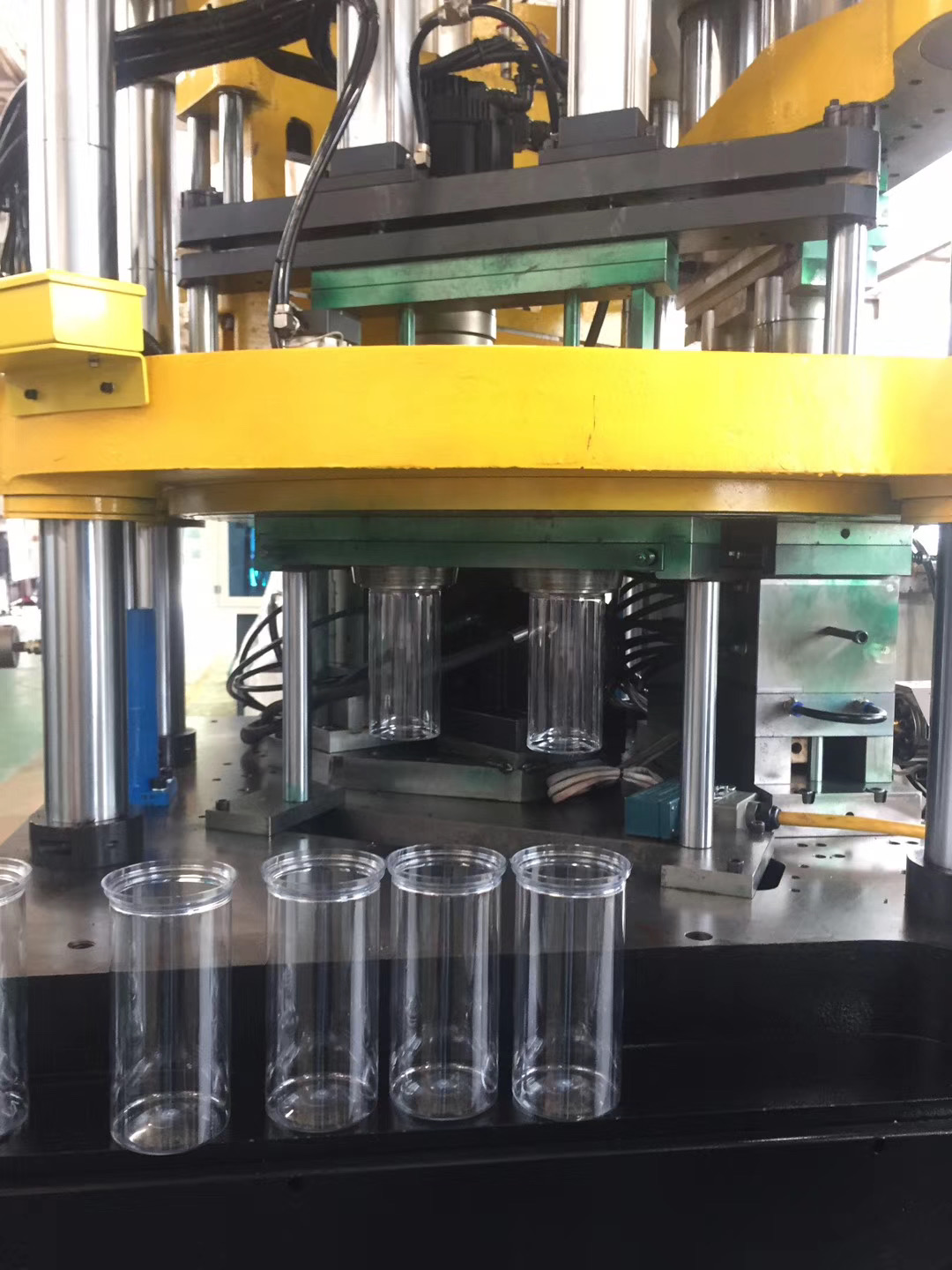
In the context of injection molding, pitch refers to the exact center-to-center distance between two adjacent cavities in a mold. This metric serves as the absolute foundation of machine sizing. Imagine trying to fit four 100mm jars into a space designed for 50mm bottles. The steel walls and cooling channels simply will not align.
A larger jar diameter inherently demands a wider pitch. For example, if you are manufacturing a jar with a 100mm diameter, the pitch must be greater than 100mm—often 120mm or more—to accommodate the necessary steel mold structure. Every ISBM machine has a fixed tie-bar spacing, which is the physical clearance between the machine's structural pillars. If the required pitch multiplied by the number of cavities exceeds this tie-bar spacing, the mold will physically not fit into the machine. Therefore, jar diameter is the ultimate limiting factor for machine capacity.
Products like peanut butter, mayonnaise, and thick cosmetic body creams require wide-mouth jars for ease of consumer accessibility. Manufacturing these specific containers necessitates a specialized wide mouth jar machine.
Wide-mouth designs present unique engineering hurdles. The injection station must push a massive volume of molten plastic over a large surface area to form the wide neck finish. This action requires highly balanced, specialized hot runner systems to prevent material degradation or uneven filling. Additionally, the blowing station must be oversized to accommodate the wide stretch rods and the expansive volume of high-pressure air required to form the jar's body. Standard bottle machines simply lack the platen space and injection capabilities to handle these rigorous wide-mouth specifications.
Selecting the correct cavity count should never be based on guesswork. Rather, it must be an objective mathematical calculation derived from your production targets. Facility managers calculate the required output per hour based on annual volume, operational hours, and estimated cycle time. However, this theoretical number must then be cross-referenced with the physical limitations dictated by the jar's diameter.
One of the most critical engineering concepts in ISBM machine selection is the relationship between cavity count and clamping force. Every time you add a cavity to a mold, you increase the projected area of the plastic being injected.
Molten plastic is injected under extreme pressure. This internal pressure acts against the mold halves, attempting to force them apart. The machine's clamping unit must apply enough counter-force to keep the mold tightly sealed. If you attempt to run a high cavity count for a large-diameter jar on a machine with insufficient tonnage, the mold will slightly open during injection. This structural failure results in flashing—a critical defect where excess plastic leaks out of the mold seams, ruining the container's threads.
To make this engineering reality actionable, here is a standard equipment sizing reference guide for ISBM platforms:
Jar Diameter Range | Max Recommended Cavities | Clamping Force Demand | Typical Industry Application |
|---|---|---|---|
30mm - 50mm | 6 to 8 Cavities | Standard | Small Cosmetic Creams, Pills |
50mm - 80mm | 4 to 6 Cavities | Medium-High | Spices, Medium Food Jars |
80mm - 120mm+ | 2 Cavities | Very High | Bulk Peanut Butter, Protein Powder |
While high cavity counts look appealing on paper for mass production, they are not always mechanically feasible. For extremely large-diameter jars, physical space and tonnage requirements often make high-cavity molds impossible on standard equipment. In these challenging scenarios, a 2 cavity ISBM machine is often the optimal engineering choice. Advanced setups can handle neck diameters up to 150mm with absolute precision. A 2-cavity setup offers lower upfront tooling costs, significantly faster mold changeover times, and the precise process control necessary for zero-defect manufacturing.
Selecting the appropriate manufacturing equipment goes far beyond matching a production quota. It requires aligning the physical physics of the machine with the geometric realities of your product. When manufacturers attempt to force a specific cavity count without respecting the limitations imposed by the jar diameter, the resulting physical mismatch inevitably leads to high defect rates.
When machine specifications are not perfectly calibrated to the product dimensions, several predictable structural defects occur. Flash on the neck finish is almost always a symptom of insufficient clamping force. If the injection pressure physically overcomes the clamping force, it pushes the mold halves apart.
Furthermore, achieving uniform wall thickness in wide-diameter containers is inherently more difficult. If the machine's stroke length or blowing pressure is calibrated for smaller diameters, the material will not distribute evenly across the wider base and walls. This leads to weak spots and structural failure during stacking.
Gate stringing and material haze are frequently related to improper thermal management. Large preforms demand larger hot runners. If the injection unit is undersized for the total shot weight, the material may degrade or cool unevenly, compromising the crystal-clear aesthetic.
The intended industry application heavily influences the optimal balance between jar diameter and cavity count. Different sectors prioritize different packaging attributes, directly translating to how the ISBM equipment should be configured.
Picture a bustling food packaging facility where a sudden spike in demand for transparent peanut butter jars requires rapid scaling. The food and beverage sector typically operates on high-volume, lower-margin models. Consequently, when investing in a food container machine, manufacturers often seek to maximize cavity counts to achieve economies of scale while maintaining strict hygiene standards.
The rise of shatterproof canning alternatives has increased the demand for specialized equipment. A dedicated PET cans machine must be engineered to produce a perfectly round, flat, and rigid neck finish. This precision is required to accept standard aluminum Easy-Open Ends. The specific neck geometry often necessitates a highly optimized cavity layout to ensure uniform injection pressure across all molds, guaranteeing an airtight seal.
In contrast to the food industry, the cosmetic and pharmaceutical sectors prioritize absolute precision, material clarity, and premium aesthetics. Cosmetic creams and high-end pharmaceutical balms often utilize jars with heavy bases, thick walls, and complex geometries designed to mimic the luxurious feel of glass.
Thick-walled PET containers require significantly longer cooling times and massive injection pressures to prevent sink marks. In these scenarios, high cavity counts are rarely the optimal choice. A smaller configuration allows the machine to direct concentrated clamping force and precise thermal control to each individual mold.
Ultimately, the decision of how to balance jar diameter and cavity count comes down to financial viability. A thorough Return on Investment analysis must account for both initial procurement costs and long-term operational efficiency.
When dealing with wide-diameter jars, buyers face a distinct financial crossroads. Investing in a massive, high-tonnage machine capable of accommodating a high-cavity mold represents a significant Capital Expenditure. It requires expensive heavy-duty tooling and a large facility footprint. Conversely, deploying multiple smaller machines lowers the initial CapEx hurdle and provides operational redundancy. If one machine requires maintenance, production does not halt entirely.
Market demands are rarely static. A packaging manufacturer producing 60mm diameter supplement jars today may need to produce 100mm diameter protein powder tubs tomorrow. Buyers are advised to select ISBM equipment with a degree of structural overhead. Investing in a machine with slightly larger tie-bar clearance and higher clamping tonnage provides a pathway for future expansion. Manufacturers can transition from producing narrow-neck bottles to wide-mouth jars simply by swapping the mold tooling, maximizing the lifespan of the asset.
Procuring the right ISBM equipment requires careful, data-driven planning rather than relying on generic specifications. The jar's diameter fundamentally dictates your mold pitch and available spatial clearance, while the desired cavity count determines the necessary clamping tonnage. Rushing this critical manufacturing decision without aligning these physical realities will inevitably lead to operational bottlenecks and high defect rates.
Before making an investment, thoroughly prepare your 3D product models, weight specifications, and target output goals. If you are ready to scale your packaging production with precision engineering, visit JASU ISBM Machines to explore specialized equipment tailored to your exact jar and can dimensions.
The maximum producible diameter is strictly dictated by the machine's specific mold pitch and the physical distance between its tie-bars. While standard compact machines might max out around 50mm to 80mm, specialized wide-mouth ISBM machines are engineered with expanded clearances that can successfully accommodate jar diameters ranging from 100mm up to 150mm and beyond, provided the machine possesses the corresponding clamping tonnage.
A 2-cavity configuration is highly advantageous when manufacturing extremely large-diameter jars where physical space prevents more cavities. Additionally, it is the preferred choice for lower production volume requirements, short-run custom manufacturing, and heavy-walled cosmetic jars. A lower-cavity setup significantly reduces initial mold tooling costs, allows for much faster mold changeovers, and ensures highly concentrated clamping force for defect-free precision.
Yes, a degree of operational flexibility is possible, provided the machine is originally engineered with sufficient baseline tonnage and tie-bar clearance. Producing both types of containers on a single machine requires interchangeable mold sets and adaptable injection units capable of handling the vastly different shot weights and thermal profiles required by narrow preforms versus wide-mouth preforms.
Standard bottle machines focus on traditional threaded neck finishes. In contrast, machines designed for PET cans must execute highly precise, specialized neck molding capabilities. PET cans require a perfectly round, exceptionally wide, and completely flat neck finish flange. This specific geometry is mandatory to ensure a hermetic, airtight seal when standard aluminum easy-open ends are seamed onto the plastic body during the final packaging phase.
The ideal wall thickness depends entirely on the application and top-load requirements. For standard food packaging, walls typically range from 0.4mm to 0.8mm to balance lightweighting with structural integrity. Premium cosmetic jars, however, may feature wall thicknesses exceeding 2.0mm to simulate the weight and premium feel of glass. Thicker walls require specialized ISBM machines with extended cooling cycles and robust injection capabilities.
Preform design is the blueprint for your final container. A wide-mouth jar requires a preform with a correspondingly wide neck and a shorter, thicker body. These wide preforms take up significantly more physical space in both the injection and conditioning stations. Consequently, engineers must space the mold cavities further apart to ensure uniform thermal conditioning and prevent the preforms from touching, which directly limits the total number of cavities a machine can hold.
