
Views: 0 Author: Site Editor Publish Time: 2026-09-23 Origin: Site


Struggling to scale plastic bottle production without blowing your budget? Guessing your equipment needs usually leads to severe production bottlenecks. Wasted capital inevitably hurts your bottom line. On the factory floor, the injection stretch blow molding machine stands as the gold standard for producing high-quality, crystal-clear PET, PP, and PC containers. Yet, facility managers constantly wrestle with one critical purchasing decision: determining the exact number of mold cavities required.
Procuring hardware based on rough estimates is a dangerous game. In this engineering guide, we will walk you through the exact mathematical calculations and the thermodynamic variables affecting your cycle speed. You will learn how to select the right equipment architecture to hit your capacity goals without over-leveraging your budget.
Math is Key: You determine the correct number of cavities by dividing your target hourly output by your machine's hourly cycle yield. Always factor in a realistic 85-90% efficiency rate.
Cycle Time Dictates Everything: Cycle speed is highly dynamic. It heavily depends on preform weight, wall thickness, resin material, and the structural rigidity of the machine.
Strategic Scalability: High-cavity configurations lower the operational cost per unit but demand higher upfront capital. They are built for continuous, high-volume runs.
Expert Sourcing: Partnering with a reliable equipment manufacturer guarantees accurate cycle estimates. You get robust machinery designed for your specific factory floor realities.
Before diving into complex production forecasting, we need to establish a baseline. How does this machinery actually operate? In plastic manufacturing, a "cavity" refers to the precisely machined hollow space inside the mold. This is where the machine injects molten resin, stretches it via a mechanical rod, and blows it with high-pressure air into its final three-dimensional shape.
The relationship between cavities and output operates on a strict 1-to-1 ratio per cycle. A single cavity produces exactly one bottle every time the equipment completes a full production loop. Consequently, a 4-cavity setup yields four bottles per cycle. An 8-cavity setup yields eight.
Understanding this mechanical limitation is critical. The number of cavities directly dictates your maximum production ceiling. Furthermore, it influences the physical footprint of the machinery, the required clamping force (tonnage), and the complexity of the hot runner system. It also drives the overall electrical and cooling energy consumption of your facility. Selecting the wrong configuration can leave you unable to fulfill client orders or stuck with a massive over-investment in unused capacity.
Recent market analyses reveal a definitive shift in procurement behavior within the packaging sector. Escalating labor costs and aggressive corporate sustainability mandates are forcing manufacturers to rethink their production lines. We are seeing a rapid migration away from older two-stage processes toward highly automated, single-stage, multi-cavity platforms.
The prevailing consensus among industrial engineers is clear. Maximizing output per square foot while simultaneously driving down energy consumption per unit is no longer just a competitive advantage. It is a baseline requirement for survival in today's industrial landscape. Facilities are now prioritizing equipment that offers precise thermal control and compact footprints to meet these aggressive modern demands.
Estimating hardware requirements should never rely on intuition. Industrial engineers and procurement managers use a standardized mathematical formula to determine the exact hardware specifications needed to hit business objectives.
To determine the required number of mold cavities, use this industry-standard equation:
Required Cavities = Target Hourly Output / [(3600 seconds / Cycle Time in seconds) × Machine Efficiency %]
To apply this formula accurately, you must lock down three core variables:
Target Output: The specific number of containers you need to manufacture per hour, shift, or month. You must account for seasonal demand spikes and planned downtime.
Cycle Time: The total time (in seconds) required to complete one full injection, stretch, and blow process. Thermodynamics primarily dictate this metric.
Efficiency Rate (OEE): The realistic operational capacity of the hardware. We typically calculate this at 85% to 90%. Machines never run at 100% capacity continuously. This buffer absorbs routine maintenance, color changeovers, operator breaks, and minor mechanical stops.
By mapping these variables correctly, you ensure your bottle production capacity aligns perfectly with your sales forecasts.
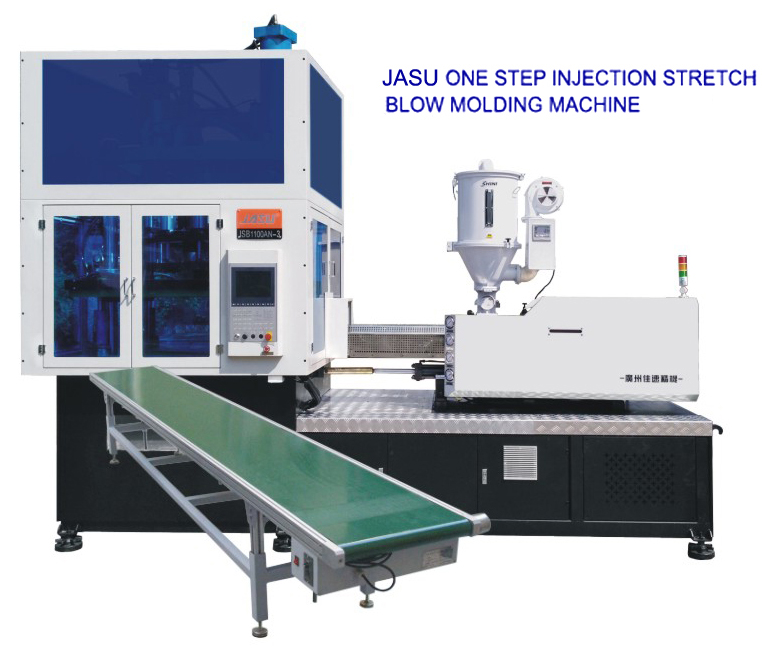
A common misconception in procurement is treating cycle speed as a fixed metric found on a spec sheet. In reality, your actual ISBM cycle time is highly dynamic. It fluctuates drastically based on the physical and chemical properties of the product you are manufacturing.
Different plastic resins possess unique thermal properties. Polyethylene Terephthalate (PET) is the industry standard for clear packaging and features a highly predictable cooling curve. In contrast, switching production to Polypropylene (PP) or Polycarbonate (PC) changes the game. PP requires different temperature profiles in the injection barrel and often takes longer to cool sufficiently in the mold before it can be transferred without deforming.
Thermodynamics plays a massive role on the production floor. The thicker the walls of your preform, the more time it takes for the plastic core to cool. If a heavy-weight cosmetic jar transfers to the blow station too quickly, the plastic remains too malleable. This results in uneven wall distribution, hazy patches, or catastrophic blowouts. Conversely, lightweight single-use pharmaceutical vials cool rapidly. This allows for significantly shorter, more aggressive cycle speeds—often hitting the 10 to 12-second mark on high-end single-stage machines.
The geometric complexity of your container also impacts the speed of the stretch rod and the high-pressure blowing phase. Simple, symmetrical cylindrical shapes allow for rapid stretching. However, asymmetric designs or containers with heavy, specialized neck finishes require precise, controlled, and often slower stretching to ensure the polymer distributes evenly.
Choosing your setup is a strategic decision balancing capital expenditure (CapEx) against operational expenditure (OpEx). To make this actionable, let's break down the standard configurations used on the factory floor.
Configuration | Target Application | CapEx / Tooling Cost | Operational Efficiency |
|---|---|---|---|
1-2 Cavities | R&D, Custom Packaging, Premium Spirits, Large Jars | Low initial investment. Cheap and fast mold changeovers. | High flexibility, but higher cost-per-unit. Ideal for short runs. |
4-6 Cavities | Pharmaceuticals, Cosmetics, Mid-volume FMCG (e.g., 10-100ml bottles) | Moderate. Requires standard hot runner systems. | The industry sweet spot. Balances excellent output volume with manageable tooling costs. |
8+ Cavities | Standard Beverage Lines, Mass Consumer Goods | High. Demands heavy-duty frames and highly complex hot runners. | Lowest cost-per-unit. Requires massive cooling infrastructure. |
Low-cavity configurations are engineered for flexibility rather than sheer volume. If your facility runs smaller batches of various designs, these molds are faster and cheaper to swap out. Upgrading to a multi cavity ISBM machine represents a higher initial investment for both the heavy-duty frame and the complex hot-runner tooling. However, the cost-per-unit drops dramatically over the equipment's lifespan. This configuration is mandatory for fast-moving consumer goods where margins are thin and output volume dictates profitability.
Let us walk through a practical mathematical example to see how these variables interact in a real-world procurement scenario.
Scenario: A packaging facility secures a contract to supply 10 million units of a standard 50ml PET cosmetic bottle annually. The facility operates 300 days a year, running two 10-hour shifts (20 hours a day).
Step 1: Determine Hourly Target. Evaluate the required hourly output. 10,000,000 bottles / 300 working days = 33,333 bottles per day. 33,333 bottles / 20 hours = 1,666 bottles per hour.
Step 2: Estimate Cycle Time. Based on the material (PET) and the lightweight design of the 50ml container, the engineering team estimates a stable cycle time of 12 seconds.
Step 3: Calculate Cycles per Hour. Determine how many cycles the equipment can theoretically complete in one hour. 3600 seconds (1 hour) / 12 seconds = 300 cycles per hour.
Step 4: Apply the Efficiency Rate. Account for material loading, routine lubrication, and minor faults using an 85% OEE rate. 300 cycles × 0.85 = 255 effective cycles per hour.
Step 5: The Final Cavity Calculation. Divide the target hourly output by the effective cycles per hour. 1,666 target bottles / 255 effective cycles = 6.53 cavities.
Since you cannot purchase a fractional cavity, you must round up. To safely meet and slightly exceed the 10-million-unit contract, the buyer must invest in an 8-cavity high output bottle machine, or run a highly optimized 6-cavity system with extended operating hours.
Even with the correct formula, theoretical mathematics can easily fall apart on the production floor. Procurement managers frequently encounter discrepancies between expected output and actual yield due to a few critical oversights.
First, ignoring the physics of cooling time is a fatal error. Focusing exclusively on the mechanical dry cycle speed while ignoring the thermodynamic properties of the polymer leads to disaster. If you try to force a faster cycle without adequate cooling time in the injection mold, you will produce warped, defective containers.
Secondly, overestimating OEE ruins capacity planning. Assuming a system will run at 100% capacity 24/7 ignores inevitable realities like resin drying times and operator shift changes. Always forecast with a safety buffer.
Finally, under-sizing auxiliary equipment creates severe bottlenecks. A high-speed multi-cavity system requires massive, immediate heat extraction. If your industrial chiller lacks the necessary BTU capacity to maintain optimal water temperatures, the mold will heat up. The operator will be forced to manually slow down the machine to prevent defects, instantly destroying your initial output calculations.
Capital expenditure requires balancing immediate production needs with long-term business scalability. You may find that a 4-cavity setup meets your current demand, but projected sales indicate you will need double that volume within two years.
Engineers often employ the strategy of "running blind molds." In this scenario, a facility purchases a machine capable of handling 6 or 8 cavities based on its clamping tonnage and injection unit capacity. However, they initially install a mold block where only 4 cavities are active. When demand scales up, the tooling can be upgraded to open the remaining cavities. This allows you to increase output without buying an entirely new machine frame.
Theoretical calculations are only valid if the machinery executes them with absolute consistency. A calculation that predicts a 12-second cycle is useless if the hardware suffers from hydraulic lag, inconsistent servo-motor feedback, or thermal instability. Over the course of a year, a two-second delay per cycle equates to millions of lost units.
Achieving stable, repeatable performance requires advanced, precision-engineered equipment. The structural rigidity of the frame, the design of the injection screw, and the precision of the clamping system directly impact your ability to maintain your calculated OEE. Partnering with a proven manufacturer like JASU ensures that your theoretical calculations match your factory floor reality. Reliable hardware minimizes unplanned downtime, protects your profit margins, and secures the exact output targets required to thrive.
Accurate equipment forecasting blends basic mathematics with a deep understanding of polymer thermodynamics. Matching the right cycle speed and cavity count protects your margins and ensures an uninterrupted supply chain. Always calculate using realistic efficiency rates, and account for the physical cooling limits of your specific container design.
Stop guessing your production capacity. If you are unsure about your exact hardware requirements, visit JASU ISBM Machines and consult with our expert engineering team. Provide your 3D bottle drawings and target output, and we will run the exact thermodynamic calculations to guide you toward the perfect machine configuration for your factory floor.
The cycle speed for a standard PET container typically ranges between 10 to 18 seconds, heavily dependent on empirical data. A small 50ml pharmaceutical vial with thin walls might achieve speeds closer to 10-12 seconds due to rapid cooling. Conversely, a 1000ml cosmetic jar with a thick, heavy base requires extended cooling in the injection cavity to prevent the polymer from crystallizing or deforming, pushing the duration to 16-18 seconds or more.
Resin type directly dictates the required injection pressure, melting temperature, and cooling time. Materials like Polycarbonate (PC) or Tritan require higher processing temperatures and longer cooling phases compared to standard PET. If a resin requires excessive cooling time, running a high-cavity mold might become inefficient or demand a machine with significantly higher clamping force and specialized cooling infrastructure to maintain structural integrity.
Clamping force requirements scale directly with the number of cavities and the projected surface area of the preforms. A standard 4-cavity machine for small bottles might require around 35 to 50 tons of clamping force. However, scaling up to an 8-cavity or 12-cavity system for larger containers often demands machine frames capable of delivering 80 to 150+ tons of force to prevent mold flashing during high-pressure injection.
Yes, but you are strictly bound by the mechanical limitations of your specific model. The primary constraints are the maximum clamping force, the physical dimensions of the tie bars and platens, and the maximum shot size of the injection barrel. You can generally reduce the number of cavities (e.g., moving from a 6-cavity to a 4-cavity mold) without issue. Upgrading to a higher cavity count is rarely possible unless the equipment was originally over-specified for your initial needs.
This decision depends entirely on your operational priorities. One large 8-cavity system is highly efficient; it consumes less total floor space, requires fewer operators, and uses less overall electrical power. However, it creates a single point of failure. Purchasing two 4-cavity systems offers critical redundancy. If one goes offline for maintenance, you maintain 50% capacity. It also provides the flexibility to run two completely different product designs simultaneously.
